Thursday, June 2, 2011

A crime puzzle

The Public Intellectual By Claude Fischer: The economy is down. Shouldn’t violent crime be up?

By Claude Fischer

Violent crime went down in America again last year. According to preliminary statistics from the FBI covering the first half of 2010. The number of violent crimes dropped by about 6 percent from the same period a year before. Given population growth, that means that the rate of violent crime dropped even more. And property crime dropped too.

This is a puzzle because crime is more common among the poor; the percentage of poor Americans has been trending up since about 2000. The economy tanked in the last couple of years. One would have expected a rise, not a fall, in violent crime.

But this head-scratcher is just part of a larger puzzle – understanding long-term trends in America’s criminal violence.

Murder History

The most reliable measure of violent crime is the homicide rate. Americans kill one another at a much higher rate – double, quadruple, or more – than do residents of comparable western European nations. This gap persists despite a roughly 40 percent drop in our homicide rate in the last 15 years or so. Americans have been notably more violent than western Europeans since about the mid-to-late 19th century.

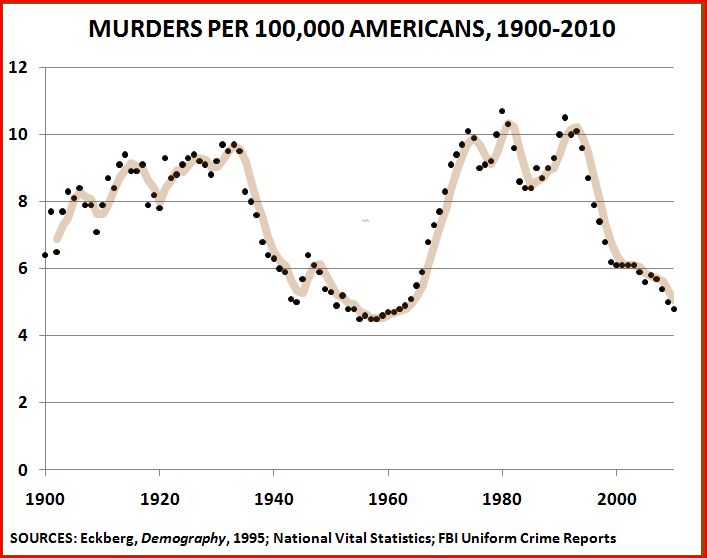
This graph shows the American homicide rate over the last century-plus. (A few notes about construction of the chart are at the end of the post.)

Homicides 1900-2010

The puzzle compounds. We see a roughly cyclical pattern: a high plateau in the 1920s and early 30s; a rapid drop of more than half to a low point in the late 1950s; then, a sharp rise, more than doubling, by 1980 and 1990. That’s followed by what will probably be a drop of about half by 2010. These are huge swings.

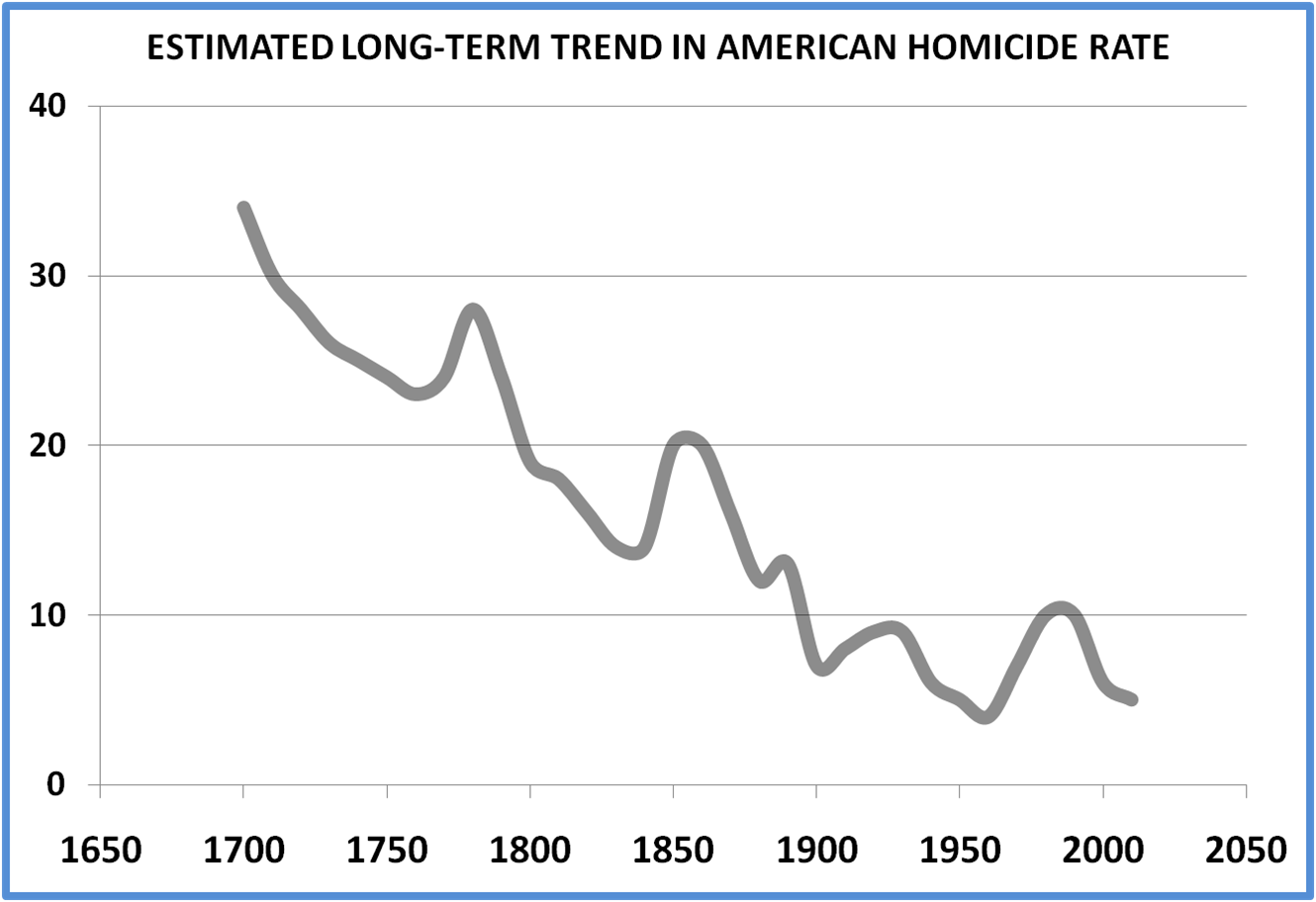
We can put this story into yet greater perspective with the graph below. The line in that graph represents my rough estimate of fluctuations in the U.S. rate of homicide over many more generations, drawing on the historical literature (see some references at the end of this post). While the details are informed guesses, the general trend is well established.

The overall story is that homicide rates declined substantially (as did rates of interpersonal violence of all sorts). The drop in violent crime in the U.S. after about 1850 was not as fast or as consistent as it was in Western Europe. That is when the striking violence gap between the U.S. and Europe opened up. The graph also shows that progress was hardly uniform, as there were many upswings of violence. Spurts often coincide with wars and the aftermaths of war – notably having many demobilized soldiers, trained and armed fighters, roaming the land. (See this paper for one analysis of the war effect.) Another short-term influence is bloody competition among armed criminals – for example, over alcohol distribution during Prohibition and over crack cocaine during the 1980s.

Scholars have offered several explanations for the centuries’-long decline of violence in the West. Here are three common ones:

Government: Over many generations, political authorities gained greater policing power and legitimacy. This allowed them to suppress criminal attacks, intergroup battles, and personal feuds. Also, court systems provided a peaceful way to resolve conflicts. And mandatory schooling swept dangerous boys off the streets.

Economics: Greater and more broadly distributed wealth reduced people’s motivation for crime and raised the costs of getting into trouble. (Barroom brawling seems less attractive if it will cost you a steady and well-paying job.) This explanation may seem to have foundered in the last several years, but in the long run – if not the short run – goes the argument, the affluent society is the pacific society.

Culture: Over the centuries, westerners increasingly came to feel that violence was uncouth and distasteful. Historians refer to the “civilizing process,” a phrase German sociologist Norbert Elias used to describe how the royal courts of Europe suppressed bloody feuds among lords. The repression of violence spread to the bourgeois who, in turn, taught it to the working classes – or forced it on them through, for example, schooling. Over time, hitting, knifing, and shooting came to seem (to most people) as vulgar as smelling from body odor or defecating in the castle hallway.

Back to the Present...

Recently, scholars have added yet another explanation: Immigration – although not in the way that some people might expect. Cities and neighborhoods that have received the largest influx of immigrants (including Mexican immigrants) have had – despite popular stereotypes to the contrary – the largest drops in criminal violence. (See, for example here and here. Thus, increased immigration may explain part of the crime drop since 1990. In a wider view, perhaps the more puzzling part of the story is the rapid upswing in violence from around 1960 to 1990 (see the first graph above).

Notes on the Chart: The basic sources are listed on the chart. Eckberg (1995) corrected the raw federal data for missing states in the early part of the century. I excluded the victims of 9/11. The 2010 point is a rough estimate from the first half of the year.
Tuesday, May 31, 2011

Money-Shredding Alarm Clock Is Completely Unforgiving [PICS]

Money-Shredding Alarm Clock Is Completely Unforgiving [PICS]: "Bringing new meaning to the phase “you snooze, you lose,” when you place this unforgiving clock across the room from your bed, if you don’t get up when the alarm sounds, it’s going to cost you.

Might we suggest at first being easy on yourself, placing a lower-denomination bill into this sleeper’s trap before you start punishing yourself too much. From the looks of these pics, that shredder does a thorough job of destroying currency or whatever else you’d like to place into it. And look at that — the designer has placed not one, but what looks like a stack of $100 bills into the clock’s hungry maw.

Monday, May 23, 2011

Once Again: Is College Worth It?

NYTimes.com:
College provides plenty of intellectual and psychic benefits alongside the potential economic ones, granted. Let’s just focus on the economic ones. Is college worth it, economically? My colleagues David Leonhardt and Floyd Norris had a blogging debate about this question, which I encourage you to go back and read. For now I’d just like to highlight a few factors to consider.

It’s true that the job market for new college graduates stinks right now. But you know what? The job market for non-graduates is worse.

People with more skills have a broader range of jobs they can do, and having a postsecondary degree sometimes serves as litmus test for employers who can be picky about hiring.

As a result, unemployment rates decline as workers become more educated:

DESCRIPTIONSource: Bureau of Labor Analysis, via Haver Analytics

College graduates also earn more money than their less-educated peers. That gulf in earnings has only widened in the last few decades: the inflation-adjusted pay of college graduates has risen, and the inflation-adjusted pay of every other group has fallen.

(Aside: People with higher degrees have even lower unemployment rates, and earn even more money.)

Additionally, in a survey of recent graduates from the Heldrich Center at Rutgers — the same survey that produced figures on graduates’ poor job prospects — respondents seemed to wholeheartedly agree that college is indeed “worth it.”

Nearly three-quarters of recent graduates said they believed their degree was as valuable now as they thought it would be when they first enrolled in college. Additionally, three-quarters said their college education did extremely well or pretty well in preparing them to be successful in their first full-time job.

That’s not to say they don’t have some regrets. About that same proportion said they would do something different if they could start college over again. Here are some of the things they’d like a redo on:

DESCRIPTION “Unfulfilled Expectations: Recent College Graduates Struggle in a Troubled Economy,” Heldrich Center for Workforce Development, Rutgers University.

Lots of people would have changed their major, or done an internship, or started looking for work sooner while enrolled. Did you notice what category of regrets got the lowest share of responses?

Wishing they hadn’t gone to college.

Tuesday, April 19, 2011

Testing and the value of education

The idea that educational degrees are just a screening tool has harmed education.  Education clearly produces useful skills like socialization, reading, mathematics, responsibility, communication skills, knowledge of facts, etc.  These are all costly to acquire and social-learning environment (classrooms) reduce the costs to most individual of acquiring them.  The recent vogue for testing is partly an effort to measure how productive schools are.  Unfortunately, the evidence indicates that standardized tests are almost useless at measuring useful skills.  For example, Heckman's research indicates that the GED is almost useless as a screening tool for measuring skills that are useful in a workplace.  Similarly, MBA programs are extremely expensive and we already have an exam to measure MBA-readiness: the GMAT.  But no companies pay a premium for potential employees who have high GMAT scores, so they indicate that they think that the GMAT is useless as a signal of skills. 
ETS has major-field tests in many disciplines, but no graduate schools use them for admission instead of an undergraduate degree .  Nor do companies use them in place of a bachelor's degree.  This indicates that they are nearly useless for employment or grad-school admission in the absence of being accompanied with a bachelor's degree.
In some fields (like math?) an exam might get close to testing actual competence, but perhaps even here it does not accomplish the same thing as an educational degree. 
The big standardized testing companies, American Council on Education (GED), ETS, ACT, and the College Board, could make millions if they could come up with a test to replace the value of a college degree.  For-profit colleges have a similar incentive.  The fact that nobody has come up with one is an indication of the value of standardized testing for measuring useful skills. 

Friday, October 15, 2010

Yglesias » “Illegal Immigrant”

Yglesias » “Illegal Immigrant”:
The increasing militarization of the US-Mexico border has tended to increase the duration of time that Mexicans who come to the US to work illegally spend in our country, but both traditionally and under a saner policy most people who cross the border would probably just go back.
People should remember that not only are wage levels higher in the United States, the price level is higher too. Consequently, the best way for Mexicans willing to migrate to maximize their real wealth is to come to the US to work and then take their money back to Mexico. Temporary labor migration of this kind has traditionally been the goal of most work-oriented border crossing and the easiest way to prevent it from turning into illegal labor and semi-permanent settlement is to create a legal channel.

Saturday, September 11, 2010

Does that make any sense?: Statistical discrimination

Does that make any sense?: Statistical discrimination: "The effects of statistical discrimination go beyond the obvious unfairness of judging an individual by his group identity. As economists have realized, there's the possibility that an entire racial group will be stuck in a bad equilibrium. If an employer believes that very few people of a particular race have invested in their job skills, he's likely to discount a good interview or test result from a member of that race as a fluke. Then, realizing that they're unlikely to get a good job anyway, people in that race will not invest in skills, confirming the employer's belief. It's a simple but lethal self-fulfilling prophecy.
Some observers, like Bryan Caplan, argue just the opposite—that statistical discrimination may be self-reversing because it raises the return to education. Caplan points out that the return to education is empirically higher for black students than white ones; he surmises that statistical discrimination makes "counter-stereotypical" behavior particularly valuable. To an extent, I think he's right. The "bad equilibrium" story doesn't seem to lower the returns to obtaining easily observable credentials like college degrees. Perhaps this is because college degrees are such good indicators of competence that they overwhelm negative racial perceptions, or because in a world that erects massive social and economic barriers to obtaining a good education, managing to get a degree as a black student is much more impressive than it is for most white students.

Monday, May 24, 2010

Super-Economy: Simple pictures against bad ideas

Super-Economy: Simple pictures against bad ideas
Unfortunately and despite their rhetoric, the Green Party has a lot of bad economic ideas. One in particular is work sharing, a government regulation that forces everyone to work as standard no more than 35-hours per week. Their idea is that if you force people to work fewer hours, there will be more job for others.

The consensus belief among academic economists is that work sharing does not work.
Unemployment does not arise because there are too many people. It is because there is some imperfection in the market (either policy induces or due to market failure) that causes the market to generally not be able to match jobs to people.

We have to remember that normally in functioning economies, there are very strong forces that create jobs for everyone who wants to work. To illustrate this for non-economists, please allow me to put up a graph with a high "duh" factor (but which really is quite important).

This is the relationship between number of working age adults in 2007 and number of jobs in 2007, for the OECD countries. Source is as usual OECD.


The correlation between potential workers and jobs in the OECD is 0.99!
...
To an economist this is trivial, and just says that there is no connection between employment rate and country size among the OECD countries. But savor the pictures for a moment. They have a profound implication. It means that there are extremely powerful forces in market economies that create jobs for ordinary people, no matter how many people we have, and regardless of if we can perfectly understand these forces.

It is not easy to describe this magic when people demand "where will jobs come from?". You may even sound naive if you say that "the market will take care of it", and refer to history or to the graph above. But in this case what sounds naive is in fact the most profound answer. Empirically, we can observe that the market does seem to take care of creating jobs.

The problems that cause unemployment is never the number of people, it is things like the skill composition combined with wage rigidity, cyclical demand conditions, search friction, taxes and regulations, and market imperfections. None of the core economic forces that create unemployment is affected by permanent work sharing for all workers.

Let me also look at this a little more directly. Here is average hours worked for workers and the unemployment rate, again for OECD, and again for 2007.


There is no statistically significant relationship between the typical workday and unemployment rate (p value 0.52). Countries that have reduces the average hours worked have not been able to achieve lower unemployment rate. Now, correlation is not always causation. Maybe the unemployment rate in France would have been even higher if they worked more hours. But I strongly doubt it.